

European Destinations Gain Popularity as Indian Students Rethink Study Abroad
Indian students are looking beyond the Big Four as Europe offers mix of cost, careers and choice
KEY TAKEAWAY
Indian students are no longer choosing countries by popularity alone. Cost, career outcomes, immigration, global exposure and ROI are reshaping the study-abroad map — with Europe increasingly entering the shortlist
Introduction
For years, Indian students had a fairly predictable study-abroad shortlist: US, UK, Canada and Australia.
That shortlist is getting longer.
Germany, Ireland and France are increasingly entering the conversation as students ask a more practical question:
“If I am spending years of savings — and sometimes taking a loan — on a master's, where does it actually make sense?”
The shift is especially interesting outside India's biggest metros, where students are becoming more willing to explore destinations that offer a different combination of affordability, career opportunities and international exposure.
And this isn't just about finding a cheaper country. The Indian student is becoming a much smarter shopper.
1. The Big Four No Longer Have an Automatic Advantage
The traditional destinations aren't disappearing. But their automatic advantage is.
Tighter immigration policies, changing post-study pathways and rising costs have made students look more closely at alternatives. The UK has moved towards tighter immigration controls, Canada has reduced international student targets, and Australia has also been recalibrating its international education and migration policies.
That doesn't mean students have stopped considering these countries. It means they are comparing them instead of assuming them.
Mr. Prateek Mohanani, Founder of the Uniflik Study Abroad Community, observes a noticeable change in the conversations students are having:
Expert Insight: Real Experiences Are Becoming Part of the Decision
“Earlier, students often started with a country or university. Today, many of them start with the outcome. They want to know what it costs, how long the course is, what the job market looks like and what happens after graduation”
The result? Europe is no longer being treated as the backup plan.
2. Tier 2 India Is Quietly Changing the Market
Perhaps the bigger story isn't which country is gaining popularity. It's who is making the choice.
More than 80% of Uniflik's audience comes from outside Mumbai, Delhi, Hyderabad and Bengaluru.
For these students, the study-abroad decision can carry a very different financial weight. A lower tuition bill, a shorter programme or a clearer career pathway can significantly change the calculation for a family investing in international education.
Germany's public-university ecosystem, Ireland's English-speaking environment and France's growing focus on Indian students are therefore becoming increasingly relevant.
Mohanani believes the change is largely being driven by greater access to information.
Expert Insight: Global Ambitions Are No Longer Limited to Metro Cities
“The ambition was always there. What has changed is access to information. Students from smaller cities can now research the same universities, understand the same career paths and compare destinations just like students from the metros”
Students increasingly want real people, not just brochures, to help them make these decisions. They want to speak to seniors, international students and people who have already experienced the journey — not simply someone selling them a destination.
That is where student communities and peer guidance are becoming increasingly valuable.
3. The Master's Degree Is Becoming an ROI Calculation
The depreciating rupee has made the cost of international education impossible to ignore.
Students are increasingly comparing:
Germany's public universities are particularly attractive from a tuition perspective, with many programmes carrying no tuition fees, although exceptions and other university costs apply.
France is also building its proposition around international students, scholarships and English-taught programmes, while Ireland continues to attract students with its English-speaking environment and strong multinational presence.
But cheap does not automatically mean good value.
Expert Insight: Look at the Return, Not Just the Cost
“The cheapest degree is not necessarily the best investment. Students are beginning to look at what they put in and what they can realistically get out of the degree”
That is a very different way of looking at a master's.
It is no longer simply education expenditure. For many families, it is a career investment.
4. France, Germany and Ireland Are Building Different Stories
Europe isn't one single study-abroad proposition.
Germany is winning attention through affordability and its large international student ecosystem. The country recorded around 420,000 international students in the 2025/26 winter semester, according to DAAD.
France is taking a more deliberate approach towards India. Its target is to reach 30,000 Indian students by 2030.
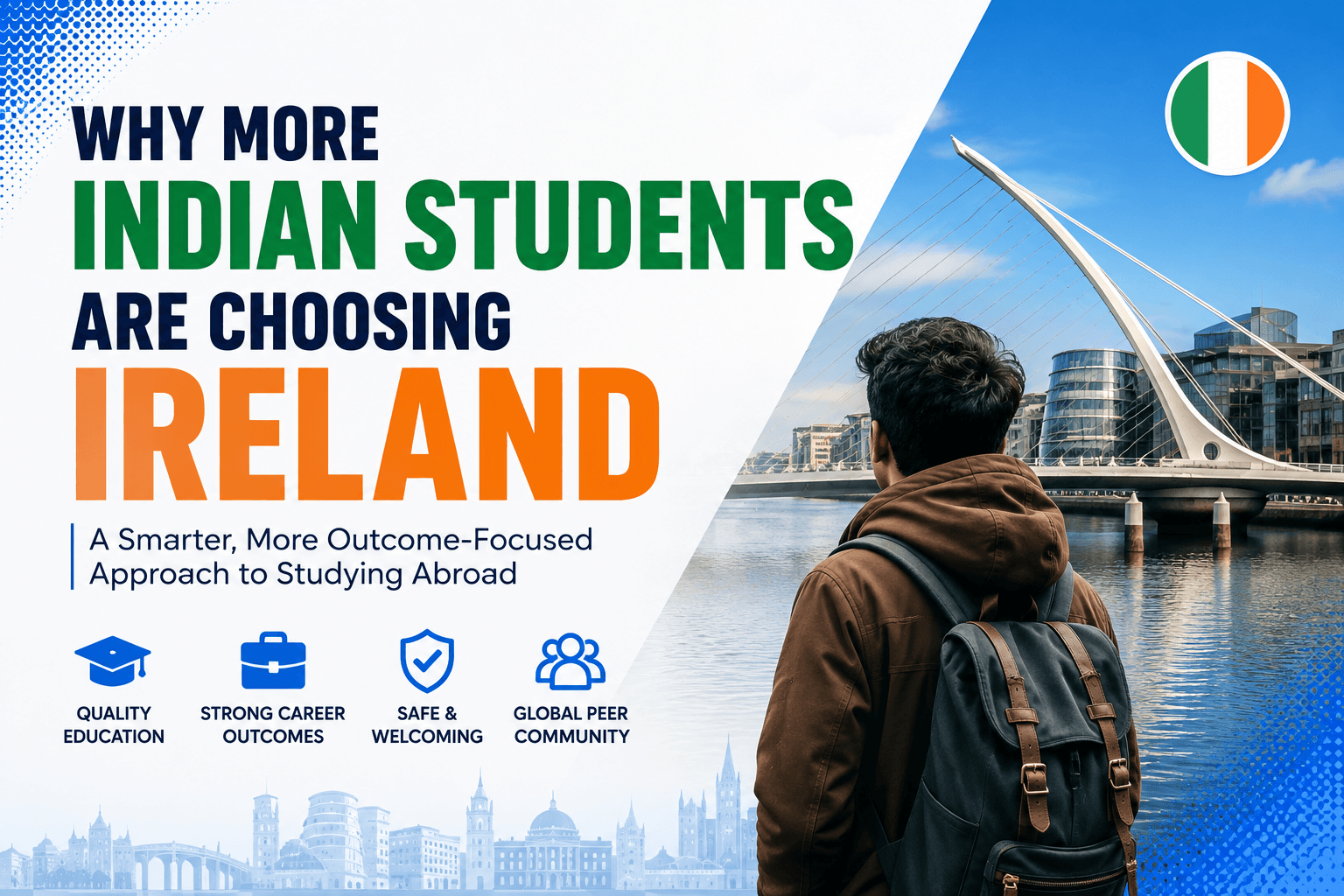
Ireland, meanwhile, offers something particularly attractive to students who want an English-speaking environment, a strong multinational presence and a post-study employment pathway. The Irish Government estimates approximately 10,000 Indian students currently in the country.
The interesting part is that these countries are not necessarily competing for the same student.
Students are increasingly matching destinations to their own priorities.
Mohanani puts it simply:
Expert Insight: There Is No Single “Best” Country
“We are seeing students ask, ‘Which country is right for my profile?’ rather than ‘Which country is best?’ That is a much more mature way of making the decision”
5. International Exposure Is Becoming Part of the Degree
There is one factor that doesn't appear neatly on a fee comparison sheet: the people students meet.
For many students, studying abroad is no longer just about attending lectures in another country. They want an international classroom, friendships across cultures, access to seniors who have already navigated the same journey and eventually a professional network that extends beyond India.
This is increasingly becoming part of the decision-making process itself.
Within the Uniflik Study Abroad Community, prospective students often look for perspectives from students already living abroad — particularly those who can explain what university life, accommodation, jobs and the transition into a new country actually feel like.
Expert Insight: The Network Matters Too
“Students don't just want an international degree anymore. They want an international network. They want people they can learn from, connect with and potentially build their careers alongside”
That makes community and peer experience an increasingly important part of the study-abroad ecosystem.
Key Takeaway
The European rise isn't simply about students looking for cheaper universities.
It is about students questioning the old definition of a ‘good’ study-abroad destination.
The new calculation combines:
Cost + Course Duration + Career + Immigration + Safety + International Exposure + ROI
And that equation is giving European destinations a much bigger role in India's study-abroad market.
Frequently Asked Questions
Are Indian students moving away from the US and UK?
Not necessarily. The US and UK remain major destinations, but students are increasingly comparing them with European alternatives rather than choosing them automatically.
Why are Tier 2 and Tier 3 students considering Europe?
Affordability, access to international education and the ability to compare multiple destinations have made European options more visible to students outside India's biggest cities.
Is Europe cheaper than the traditional study-abroad destinations?
Not always. The overall cost depends on tuition, living expenses, exchange rates and programme duration. Germany, for example, can offer significant tuition advantages at many public universities.
Are students only choosing Europe because it is cheaper?
No. Career opportunities, immigration pathways, international exposure, safety and the ability to build a global network are increasingly part of the decision.
Conclusion
The biggest change in India's study-abroad market may not be where students are going.
It may be how they are choosing where to go.
The old model was simple: pick a popular country, find a university and apply.
The new model is considerably more demanding.
Students are comparing countries, questioning costs, researching career outcomes, speaking to people already abroad and thinking about what their life could look like several years after graduation.
For Europe, that creates a significant opportunity.
For Indian students, it creates something even more valuable:
choice.
And when students have more choices, popularity alone stops being enough.
The next study-abroad winner may not be the country with the biggest brand. It may be the country that makes the most sense.
Need Help Choosing the Right University?
Our experts can help you shortlist the best universities based on your goals.
On This Page
Download Free Guide
Thisi is description
Related Articles


Popular Universities



Need Help?
Talk to our experts
Our experts are here to help you plan your study abroad journey.
Chat with ExpertUniflik Tech Private Limited, All Rights Reserved